Constant challenge for a better environment ECO Innovation, Green Future
R&D
Integrated Energy System
From Ammonia to Hydrogen, From Hydrogen to Power
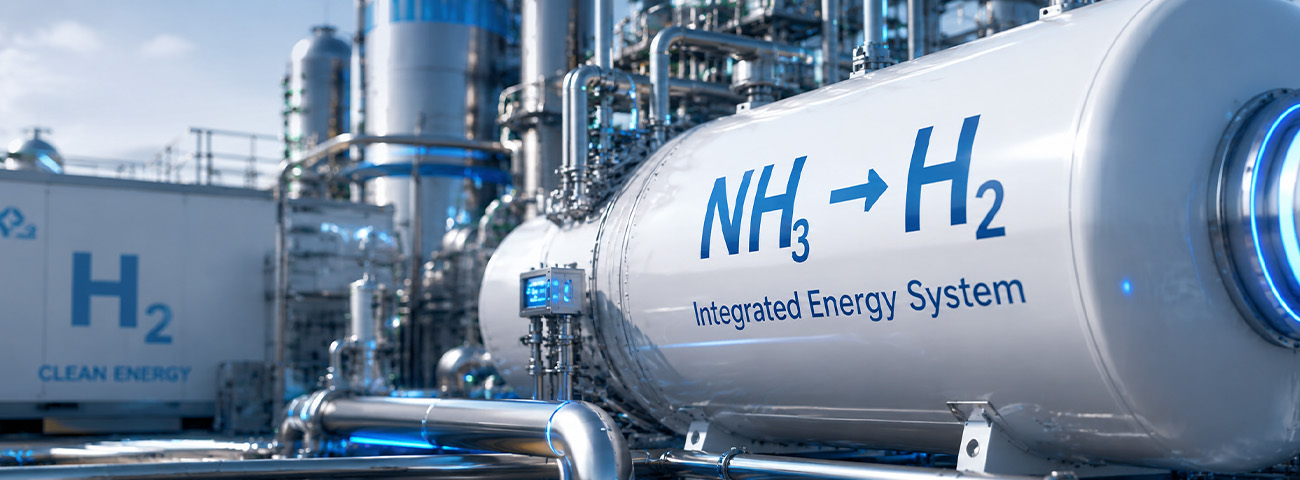
Seowoin's ammonia-hydrogen integrated energy system is an energy conversion system that packages ammonia cracking, hydrogen purification, and fuel cell integration into a single unit. Ammonia is an energy carrier for storing and transporting hydrogen, which can be converted back to hydrogen at the point of demand. Seowoin is developing an integrated system that converts ammonia to hydrogen, produces high-purity hydrogen through a purification process, and then generates electricity in conjunction with a fuel cell.
SYSTEM FLOW
-
01

NH₃ Storage
-
02

Cracking
-
03

Purification
-
04

Fuel Cell
-
05

Power
-
01 Ammonia Storage & Supply
Stores liquefied ammonia and stably supplies it in accordance with system operating conditions.
-
02 Ammonia Cracking
Decomposes ammonia into hydrogen and nitrogen through a catalytic reaction.
-
03 Gas Separation Membrane
Performs primary separation of hydrogen from the cracking mixed gas.
-
04 PSA
Removes residual nitrogen and impurities to produce high-purity hydrogen.
-
05 PEMFC Fuel Cell
Converts purified hydrogen into electricity.
System Components
Ammonia Cracking Reactor
Core reaction device that converts ammonia into hydrogen and nitrogen.
Hydrogen Purification Unit
Combines gas separation membrane and VPSA to produce high-purity hydrogen suitable for supply to fuel cells.
Hydrogen & Air Humidifier
Controls humidity conditions for hydrogen and air required for PEM fuel cell operation.
Heat Exchanger & Thermal Management System
Recovers and utilizes waste heat from the reactor, exhaust gas, and fuel cell to improve system efficiency.
PLC Control System
Provides integrated control of temperature, pressure, hydrogen purity, valve actuation, thermal management, and emergency shutdown functions.
PEMFC Fuel Cell
Power generation device that converts purified hydrogen into electricity.
Application
-
01 Maritime
Through ammonia-based hydrogen production and fuel cell power generation, this can be extended to auxiliary power for ships, propulsion systems, and port power supply. Examples: coastal vessels, government vessels, passenger ships, cruise ships, port equipment, ship auxiliary power.
Examples: coastal vessels, government vessels, passenger ships, cruise ships, port equipment, ship auxiliary power. -
02 Power Generation
Can be utilized for land-based power generation, distributed power, and emergency power in conjunction with ammonia storage infrastructure. Even in areas with insufficient hydrogen pipeline networks, on-site hydrogen production and power generation based on ammonia is possible.
Examples: distributed power, off-grid power, industrial complex power supply, emergency power, microgrids. -
03 Heavy Industry
Ammonia-based hydrogen supply technology can be applied to industrial processes requiring high-purity hydrogen. It can be used as a hydrogen supply source for low-carbon process transition in steel, chemical, refining, and materials industries.
Examples: steel, chemical processes, refining, materials industry, industrial heat sources. -
04 Heavy Mobility
Large mobile units requiring long-range operation and high output may be difficult to address with batteries alone. Ammonia-based hydrogen conversion systems can be extended as clean power systems for commercial vehicles, heavy equipment, and special mobile units.
Examples: buses, trucks, construction equipment, special vehicles, mobile power generation systems.
SYSTEM EFFICIENCY
| Parameter | Performance |
|---|---|
| Ammonia Cracking Temperature | 500℃ |
| Ammonia Cracking Pressure | 6bar |
| Ammonia Cracking Pressure | ≥ 98% |
| Hydrogen Recovery Rate | ≥ 95% |
| Hydrogen Purity | ≥ 99.99% |
| Energy Efficiency | ≥ 40% |



About us
Seowooin Co., Ltd. ㅣ CEO : CHOUNG HWAN JANG ㅣ Business Registration Number : 417-88-01656
Head Office / Factory : 108, Haeryongsandan 6-ro, Haeryong-myeon, Suncheon-si, Jeollanam-do 58023, Republic of Korea (Seowooin Co., Ltd.)
COPYRIGHT © 2024 SEOWOOIN CO.,LTD ALL RIGHTS RESERVED
CS CNETER
TEL : 070-7731-5452
FAX : 061-989-8603
E-mail : swi@seowooin.com